Alternative stress blocks

General stress blocks​

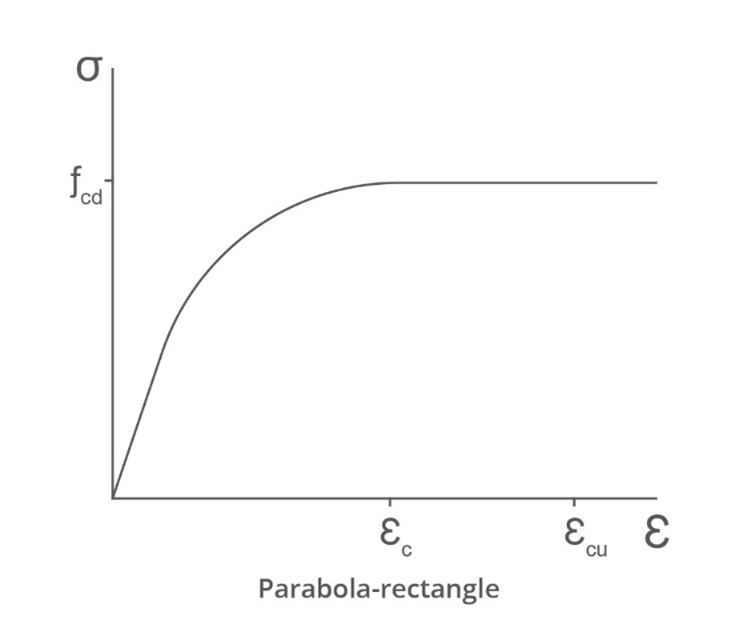
Parabola-rectangles are commonly uses for concrete stress-strain curves. The parabolic curve can be characterised as

ffc=a(εεp)2+b(εεp)\frac{f}{f_c}=a\left(\frac{\varepsilon}{\varepsilon_p}\right)^2+b\left(\frac{\varepsilon}{\varepsilon_p}\right)

Define

f′=ffcf^{\prime}=\frac{f}{f_c}

and

η=εεp\eta=\frac{\varepsilon}{\varepsilon_p}

Parabola-rectangle diagram with formula for calculating concrete stress-strain curves.

If the curve is taken to be tangent to the plateau then at n=1,f′=1n=1, f^{\prime}=1 and df′dη=0\frac{d f^{\prime}}{d \eta}=0.

Solving for the coefficients gives a=−1a=-1 and b=2b=2 so

f′=2η−η2f^{\prime}=2 \eta-\eta^2

The area under the curve is given by

Ap=∫01f′dη=[η2−η33]01=23A_p=\int_0^1 f^{\prime} d \eta=\left[\eta^2-\frac{\eta^3}{3}\right]_0^1=\frac{2}{3}

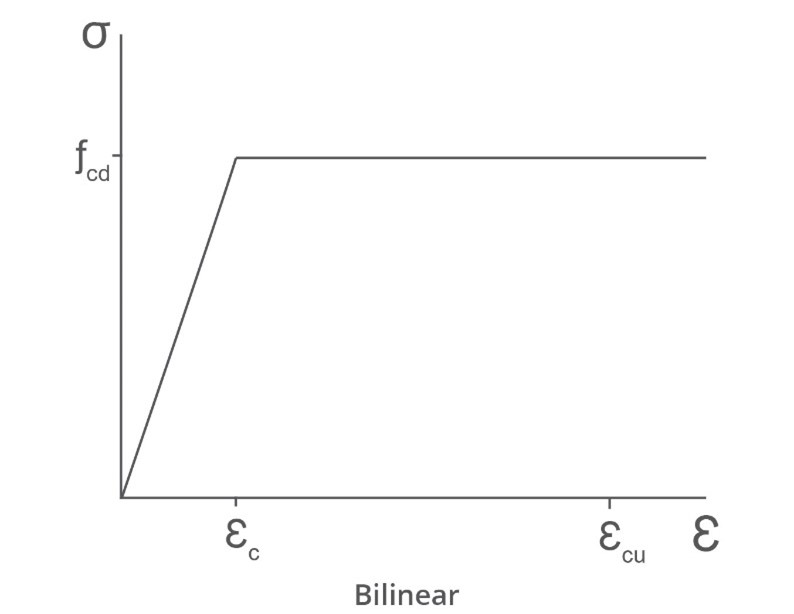
For bi-linear curve with the strain transition at εb\varepsilon_b the area under the curve to εp\varepsilon_p is

Bilinear diagram with formula for calculating strain transition.

Ab=ηb2+(1−ηb)=1−ηb2A_b=\frac{\eta_b}{2}+\left(1-\eta_b\right)=1-\frac{\eta_b}{2}

Equating the areas

1−ηb2=231-\frac{\eta_b}{2}=\frac{2}{3}

or

ηb=23\eta_b=\frac{2}{3}

So

εc,b=23εc,p\varepsilon_{c, b}=\frac{2}{3} \varepsilon_{c, p}

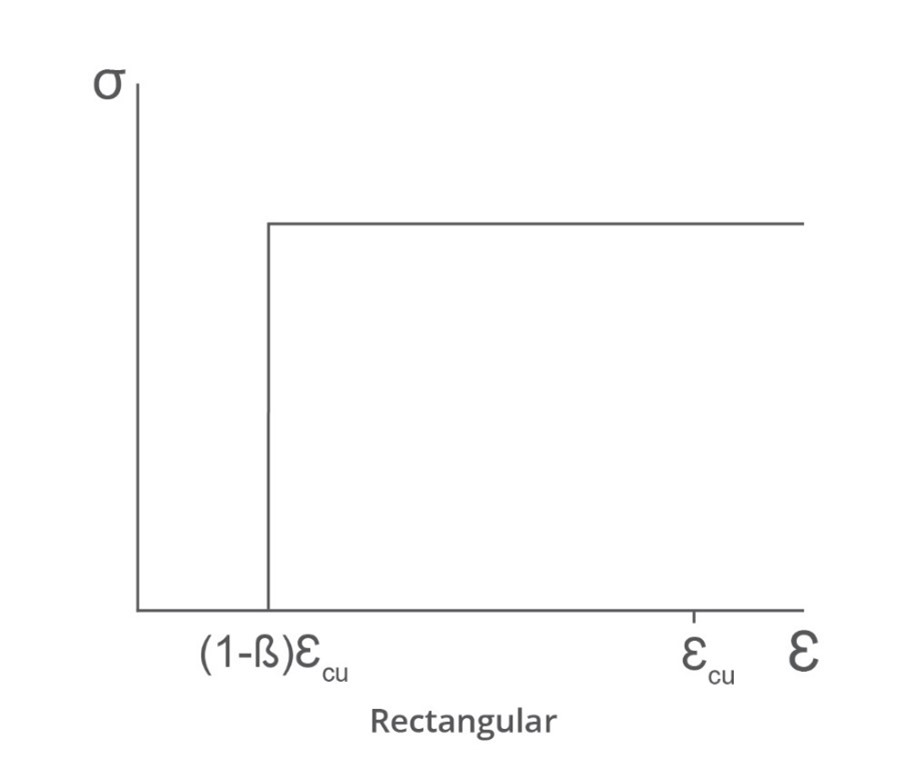
For a rectangular stress block with the strain transition at εr\varepsilon_r the area under the curve to εp\varepsilon_p is

Rectangular stress block diagram with formula

Ab=1−ηrA_b=1-\eta_r

Equating the areas

1−ηr=231-\eta_r=\frac{2}{3}

or

ηr=13\eta_r=\frac{1}{3}

so

εcJ=13εc,p\varepsilon_{c J}=\frac{1}{3} \varepsilon_{c, p}