The response of a single degree of freedom system mode (frequency f,
spectral acceleration aspectral) is
qi=(2πf)2aspectral
Modal analysis reduces a complex structure to an equivalent system of
single degree of freedom oscillators so this can be applied to the
structure as a whole for any selected mode. The response in a given mode
i in direction j is
xji=Γij(2πfi)2aspectralϕi
Where Γij is the participation factor to account for the
direction of excitation. The term
Γji(2πfi)2aspectral
is the modal multiplier.
For global x and y we use Γx & Γy. So for excitation
at an angle α we want to use Γα. Going back
to the definition of the participation factor in x and y directions:
Γx=mϕTMxΓy=mϕTMy
Where x and y corresponds to a rigid body displacement in the respective
direction. So the rigid body vector at α is
rα=xcosα+ysinα
And the orthogonal direction α′ would have a rigid body vector
rα′=−xsinα+ycosα
This means that for a rotated excitation direction we just need to
rotate the participation factors and we don’t need to transform the
displacements, etc.
That leaves the only transformation we need being the transformation of
global displacements to local for nodes in constraint axes. For these we
want to transform modal results from global to local, do the combination
and transform combined value from local to global.
The modal responses are then combined using one of several combination
methods.
In SRSS method, the spectra sx,sy are applied to 100% on the
principal directions. The responses obtained from SRSS combination has
equal contributions from all the directions. However, in practice the
same ground motion will not occurs in both the direction. Therefore,
SRSS yields conservative results.
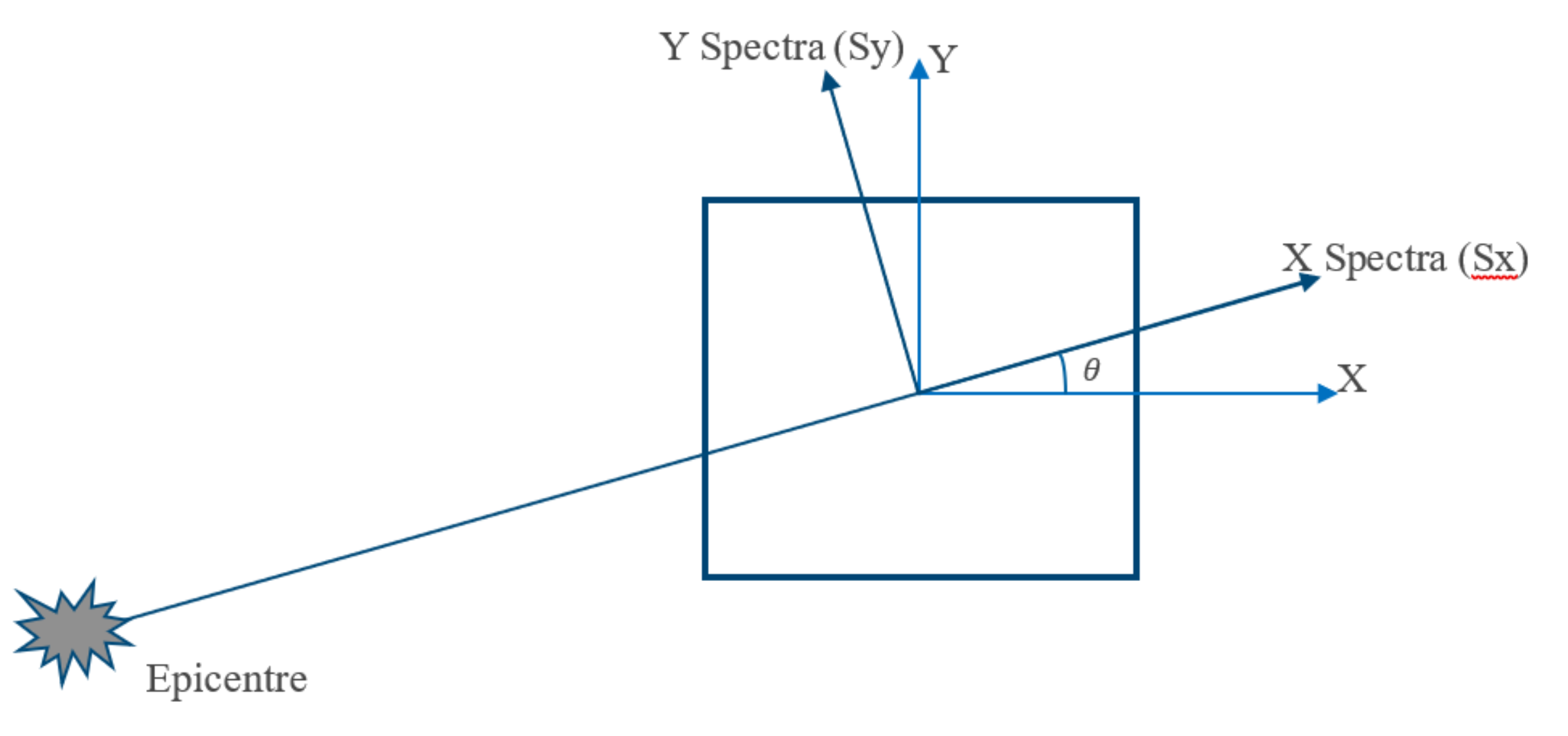
Menun and Der Kiureghian4 (1998) presented the CQC3 combination
method for combination of the orthogonal spectrum. Let assume
sx,sy are the major and minor spectra applied at an arbitrary
angle θ from the structural axis. To simplify the analysis
further assume the sy spectra is some fraction of sx spectra.
sy=a×sx
The peak response value can be estimated using the fundamental CQC3
equation
and qxi,qyi are the modal quantities produced by spectrums
applied at x and y directions, qzi is the modal value produced by
the vertical spectrum and θ is the arbitrary angle at which the
lateral spectra is applied.
Normally, the value of θ is not known. The critical angle that
produces maximum response can be calculated using
If the value of a=1, CQC3 combination reduces to SRSS combination.
The peak response value is not dependent on the θ and the peak
response can be estimated using.
Qmax=Qx2+Qy2+Qz2
There is no specific guidelines available to choose the value of a.
Menun and Der Kiureghian presented an example for CQC3 combination with
a value ranging from 0.50 to 0.85.
The storey inertia forces can be calculated from the storey mass, m, and
inertia, Izz, response spectrum and the modal results. The
storey modal translations (ux,uy)and rotations
(θz) are calculated (see below)
The force and moment for excitation in the ith direction are
then determined from
Where scode is the code scaling factor, aspecis the spectral
acceleration and Γi the participation factor.
2Wilson, der Kiureghian & Bayo, 'Earthquake Engineering and Structural Dynamics', Vol 9, pp 187-194 (1981)
3ASCE 4-09 Seismic analysis of safety related nuclear structures and commentary', Chapter 4.0 Analysis of Structures (2009)
4Menun, C., and A. Der Kiureghian. 1998. “A Replacement for the 30 % Rule for Multicomponent Excitation,” Earthquake Spectra. Vol. 13, Number 1. February.